
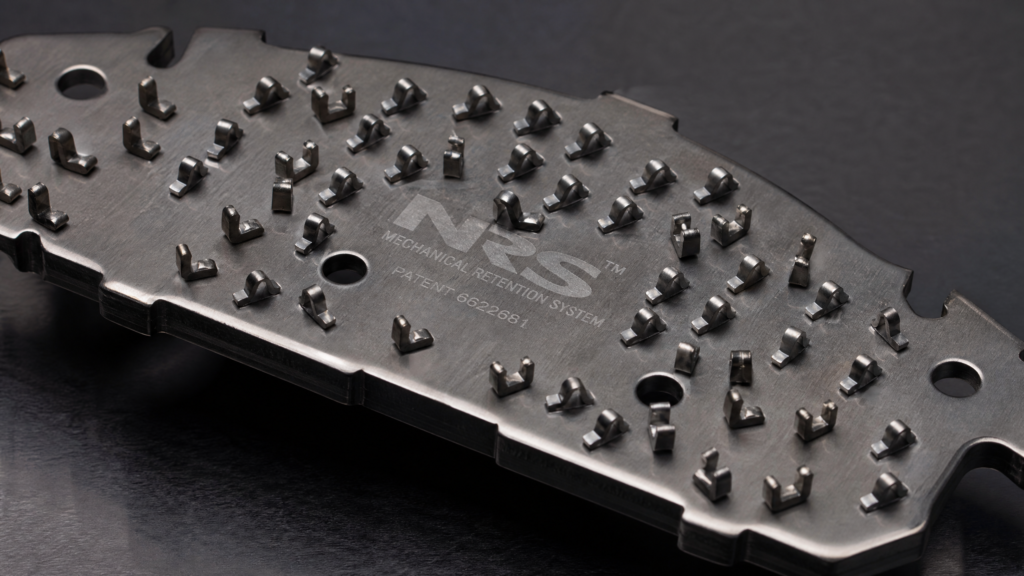
In the manufacturing process of brake pads, the backing plate plays a crucial role. It is not only the carrier of the friction material but also the core component that transmits braking force. Traditional brake pad manufacturing heavily relies on adhesives to secure the friction material to the backing plate. However, under extreme high temperatures and harsh braking environments, adhesives can degrade and fail, leading to the detachment of the friction material and causing severe safety hazards.
To address this industry pain point, mechanical retention technology emerged, with the NRS (Nucap Retention System) technology being the most representative. NRS technology creates a dense matrix of raised steel hooks on the surface of the backing plate through stamping. During the hot pressing process, the friction material deeply embeds into these hooks, forming an unbreakable mechanical bond. This bonding method does not rely on chemical adhesives, thus offering exceptional heat resistance and shear strength.
Backing plates utilizing mechanical retention technology ensure that the brake pad maintains structural integrity throughout its entire lifecycle, significantly enhancing vehicle braking safety. For brake pad manufacturers pursuing high quality, incorporating backing plates with NRS or similar mechanical retention technologies is a critical step in boosting product competitiveness.