
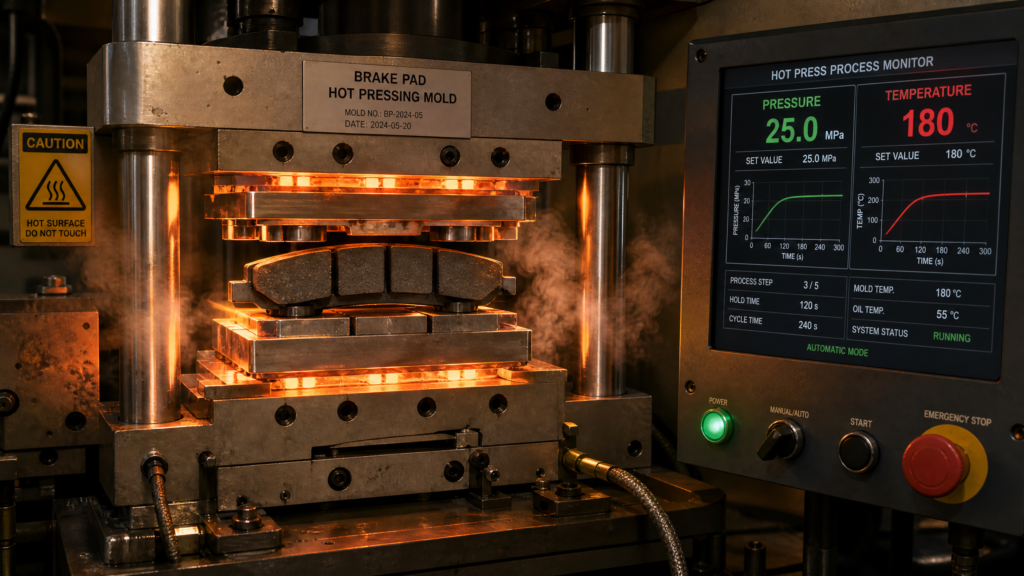
Hot pressing is one of the most critical stages in brake pad manufacturing, directly determining the product’s density, hardness, porosity, and ultimately, its friction performance. This process is not merely about applying pressure and heat but is an art of precisely controlling pressure, temperature, and time.
During hot pressing, the pre-formed friction material block is first placed into a mold. The pressure applied by the hydraulic press forces the material particles to bond tightly, eliminating internal voids. Simultaneously, the mold is heated to a specific temperature, causing the resin binder in the friction material to soften and undergo a cross-linking curing reaction. The method of pressure application (e.g., stepped pressing, holding pressure) and the temperature curve (heating rate, holding time) must be precisely adjusted according to the specific characteristics of the friction material formulation.
Modern brake pad hot pressing equipment is typically equipped with advanced PLC control systems and high-precision sensors, capable of real-time monitoring and feedback of pressure and temperature data, ensuring parameter consistency for each production cycle. By optimizing the hot pressing process, not only can the mechanical strength and wear resistance of the brake pads be improved, but their thermal fade performance can also be effectively controlled, thereby ensuring stable braking performance under extreme conditions.