
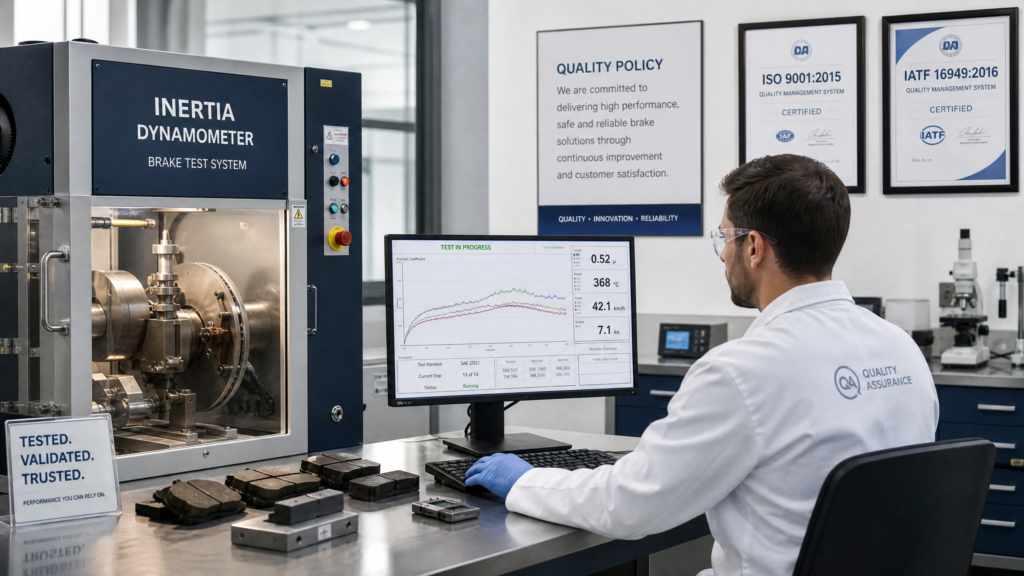
For an international trade independent website, ensuring that the promoted brake pad products comply with international quality standards is the cornerstone for gaining customer trust and expanding into global markets. In the globalized brake pad supply chain, a stringent quality control system is indispensable.
Key international quality management systems include:
•ISO 9001: An internationally recognized standard for quality management systems, ensuring that enterprises have stable product quality and capabilities for continuous improvement.
•IATF 16949: Specific requirements for quality management systems in the automotive industry. It builds upon ISO 9001 by adding special requirements for the automotive sector, serving as a “golden ticket” to enter the global automotive supply chain.
Beyond system certifications, performance testing of the products themselves is equally critical. For example, Link testing and inertia dynamometer testing are authoritative methods for simulating real-world driving conditions and evaluating brake pad friction coefficients, wear rates, thermal fade, and noise performance. Through these tests, it can be verified whether products comply with international regulatory standards such as ECE R90 (Europe) and SAE (United States).
A comprehensive quality control process should span every link from raw material procurement, manufacturing, to finished product dispatch. This includes not only strict supplier selection and online inspection during production but also comprehensive performance testing of the final products. Only through such rigorous quality assurance can we ensure that every brake pad delivered to global customers possesses outstanding quality and reliable safety.