
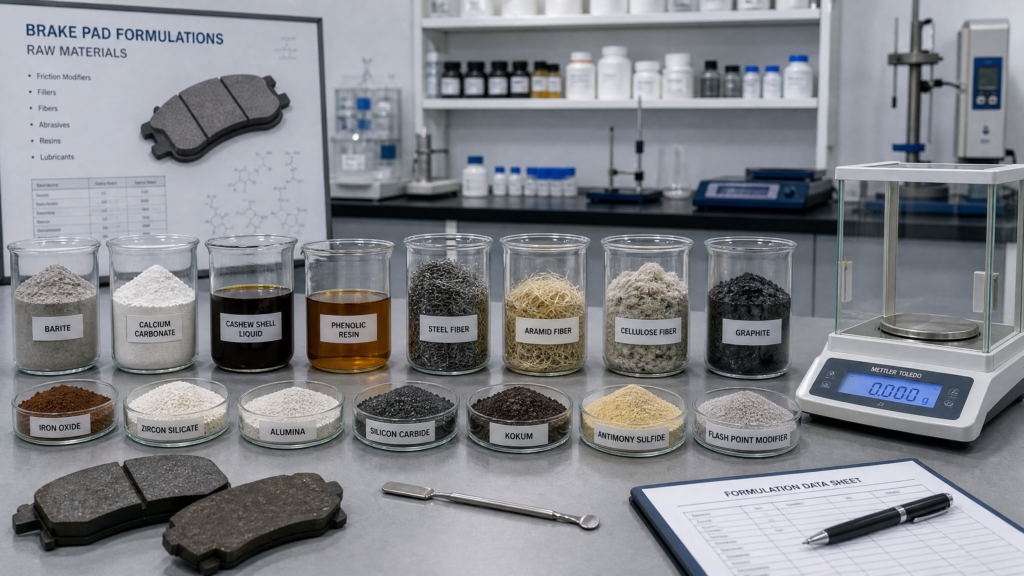
At the heart of a brake pad’s performance lies its friction material formulation. An excellent friction material formulation needs to find the optimal balance among multiple dimensions, including braking efficiency, wear resistance, noise control, thermal fade, and rotor wear. This science of formulation involves the precise proportioning of dozens or even hundreds of raw materials.
Common types of friction materials include:
•Semi-Metallic Formulations: Containing 30%-65% metallic fibers (e.g., steel fibers, copper fibers), offering excellent braking performance and heat dissipation, but may generate noise and cause significant rotor wear.
•Low-Metallic Formulations: With metallic content below 30%, these formulations use more organic materials to reduce noise and wear while maintaining good braking effectiveness.
•Ceramic Formulations: Primarily composed of ceramic fibers, non-metallic fillers, and binders, known for their ultra-quiet operation, low dust, and long lifespan, with minimal rotor wear, though initial braking might be slightly less aggressive.
Formulation engineers design and adjust recipes based on the target vehicle type (passenger cars, commercial vehicles), driving habits, climate conditions, and regulatory requirements. For instance, commercial vehicle brake pads prioritize stability and wear resistance at high temperatures, while passenger car brake pads focus more on comfort and quietness. Through precise formulation design, high-quality brake pads that meet diverse market demands can be produced.